How to Read Your First Research Paper: A Student's Guide to Where to Start, What to Look For and How Long It Takes
Reading a research paper for the first time is slow and confusing because a paper is not written to be read top to bottom. Where to start (not the first line), the five things every paper answers and where they are, how long it really takes, how to take notes, what to do when English is not your first language, and an app made for students reading their first papers.
If you have just been handed your first research paper, for a lab, a seminar or your senior thesis, and you are reading it the way you read a textbook, from the first line to the last, that is the reason it is slow and the reason it does not stick. A paper is not written to be read in order. It is written for other experts, and it puts the same five things in the same places every time. Reading it means knowing where to look, in what order, and when to stop.
This guide is for students reading their first papers. It covers where to start, what to look for, how long it takes, how to take notes, what to do when the paper is in English and English is not your first language, and what to do when you still do not understand it. At the end there is an app built for exactly this, but nothing below depends on it.
Why a research paper is not read like a textbook
Almost every empirical paper has the same skeleton: an abstract, an introduction that ends with what the paper asks, a methods section, results with figures and tables, a discussion that says what it means and what it cannot show, and a reference list. The order is for the authors' convenience, not the reader's. The result you came for is in the figures and the conclusion; the hardest part, the methods, is in the middle; and the one paragraph that tells you what the paper is actually about is usually the last paragraph of the introduction.
So the first rule: you are not going to read it once, top to bottom. You are going to read it two or three times, each time looking for something specific. This is the three-pass method from S. Keshav's "How to Read a Paper". Keshav is a computer scientist, then at the University of Waterloo, and the two-page guide he wrote in 2007 is the one handed to new graduate students in many fields with the words "read this first". We describe it in full in How to Read a Research Paper: The Three-Pass Method. Here is how it works when it is your first paper.
Where to start: the first ten minutes
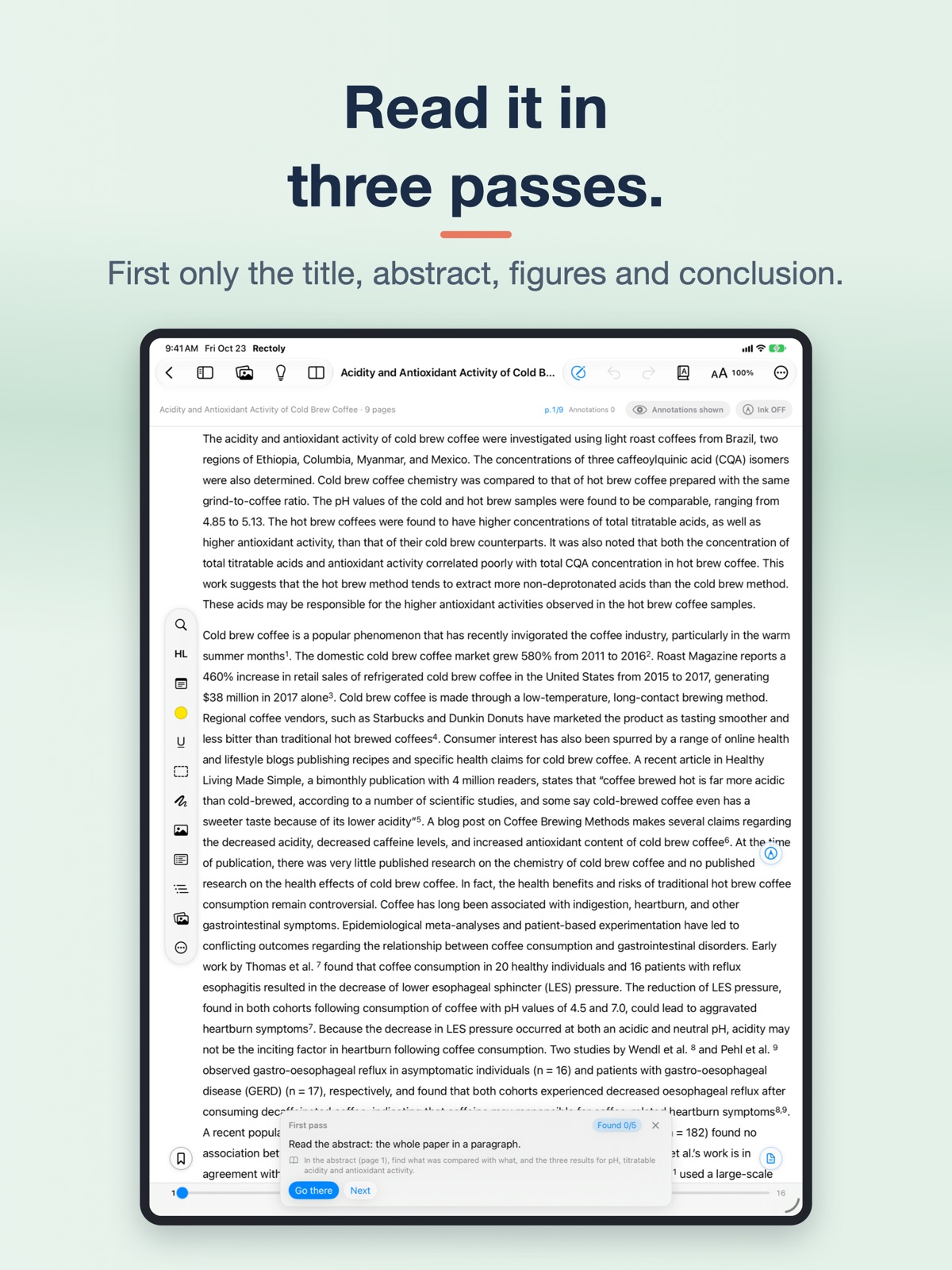
Read, in this order, and nothing else:
- The title and the abstract. Twice. The abstract is the whole paper in 200 words; most of what you need to say about the paper in a seminar is here.
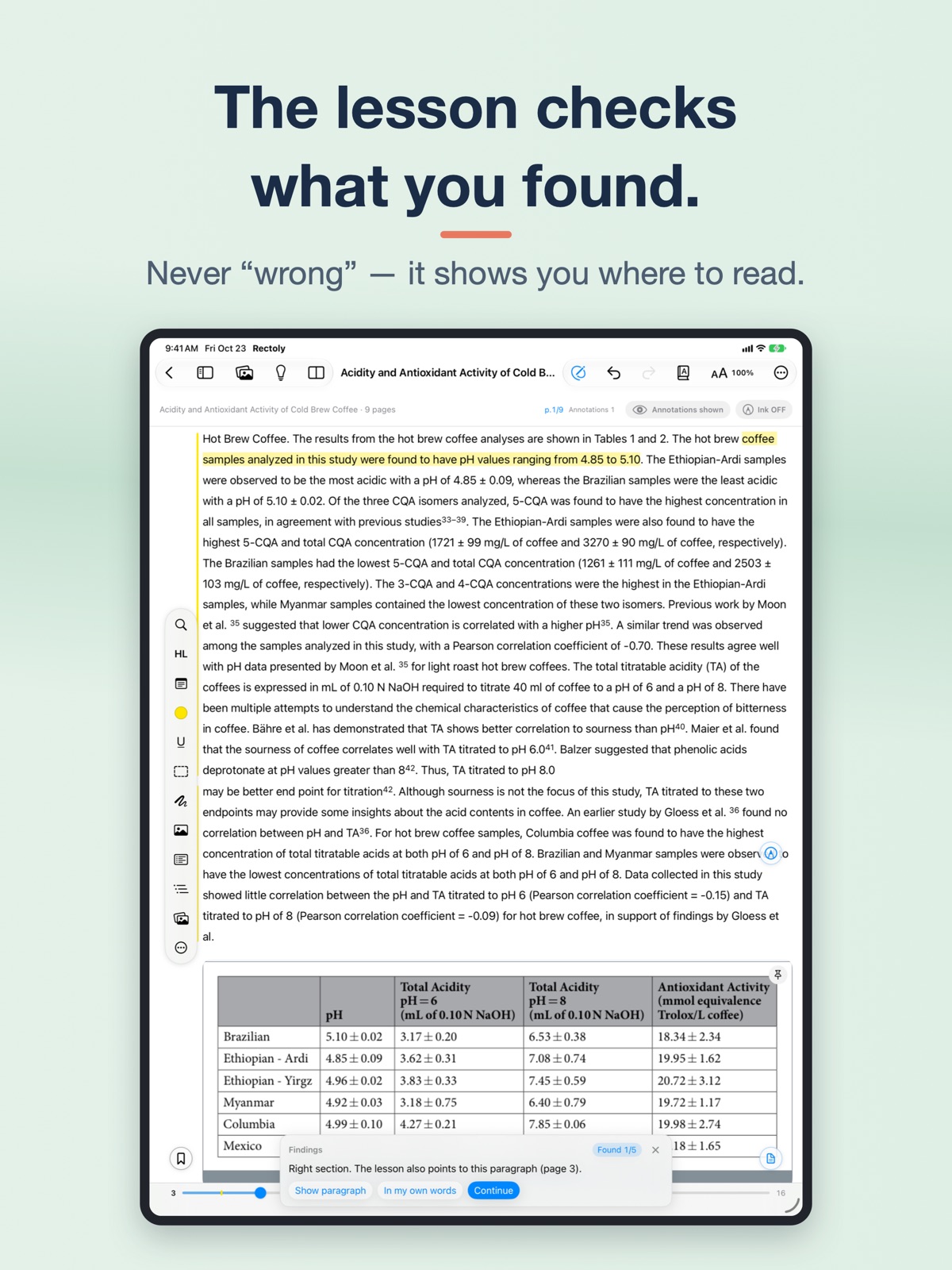
- The figures and tables, with their captions. Do not read the text around them yet. Ask of each one: what is on the axes, and what is the one thing this figure shows?
- The last paragraph of the introduction. This is where authors say "in this paper, we…". It is the sentence you will be asked about.
- The conclusion. What the authors claim to have shown.
That is five to ten minutes, and you now know what the paper is about, roughly what it found and whether you can follow it. If it is for a seminar you will go on. If it is one of thirty papers for your thesis, this pass is often where you decide it is not one of yours, and that is a successful reading, not a failed one.
What to look for: the five questions every paper answers
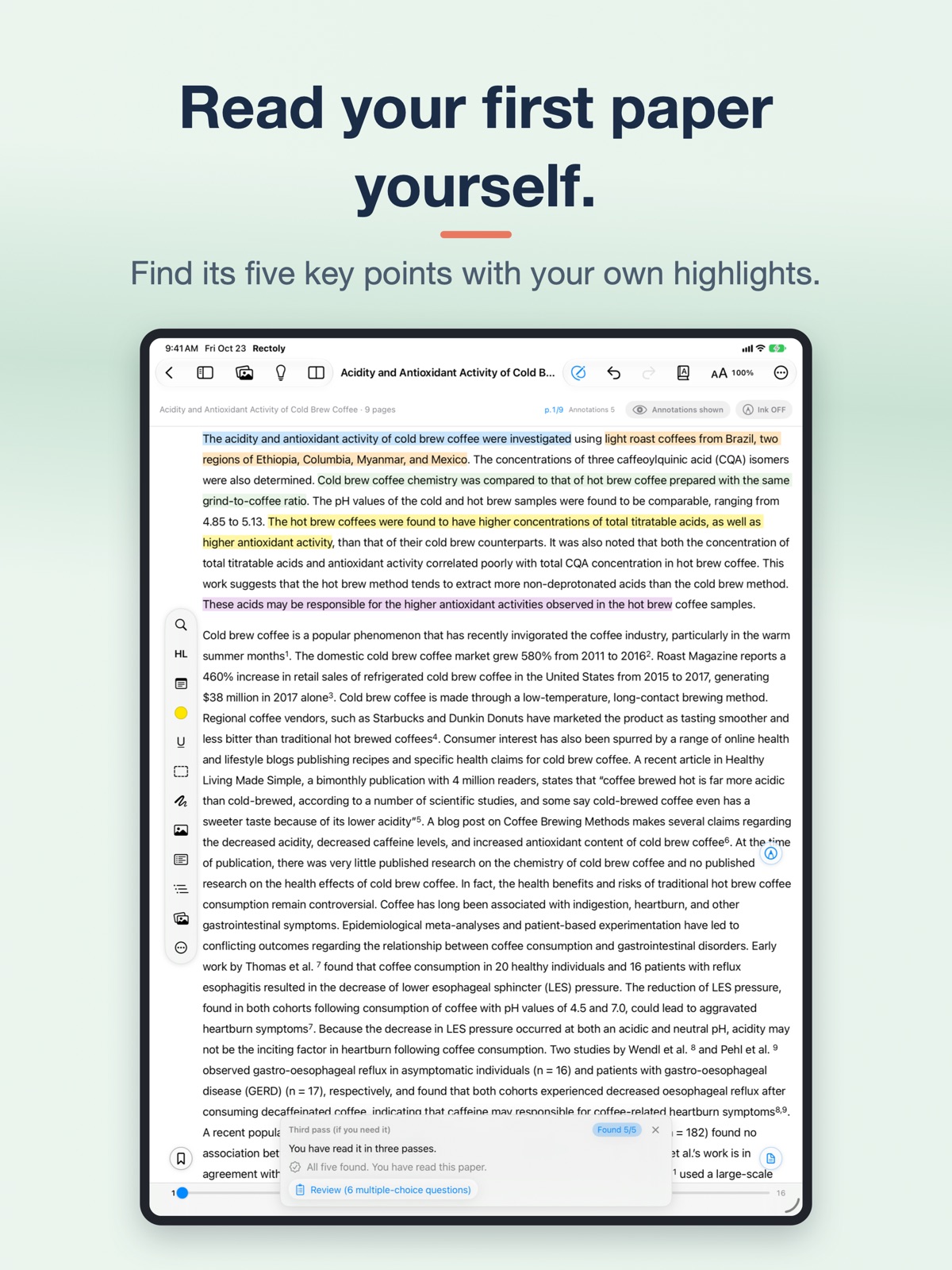
Every empirical paper answers five questions, and each one lives in a predictable place. If you can point to where the paper answers each of them, you have read the paper.
| Question | What you are looking for | Where it usually is |
|---|---|---|
| Research question | What the paper asks, in one sentence | End of the introduction; the abstract |
| Method | How they went about answering it: experiment, survey, model, analysis of existing data | Methods, and the first lines of the results |
| Data | What they measured or whom they studied, and how much: the sample, the dataset, the period | Methods, Table 1 |
| Findings | The two or three results the paper rests on, with the numbers | Results; the figures; the abstract's last sentences |
| Limitations | What the authors themselves say the study cannot show | Discussion, often a paragraph beginning "Our study has several limitations" |
These are the same five fields a researcher fills into a literature review matrix for every paper, so the habit you build on your first paper is the one you will use for the next hundred.
A practical way to do it: for each question, find the sentence or paragraph where the paper answers it, highlight it, and write one line in your own words in the margin. Not a copy of the sentence; your own line. If you cannot write the line, you have not found the answer yet, and that is useful to know.
The second time through: the figures and the text around them
Now read the paper properly, but with a purpose. Go figure by figure: read the caption, then find the paragraph in the results that describes that figure, and read that. Check that the text claims what the figure shows and no more. Mark anything you do not follow, and mark the references the authors lean on, but do not chase them yet. Skip the details of the methods and any derivations; you are after what was done and what was found, not whether you could do it yourself.
By the end of this pass you should be able to tell someone what the paper asked, how it answered, and what it found, with its main figure in front of you. For most seminar readings and most thesis papers, that is where you stop. Only the few papers closest to your own work need the third pass, where you work through the methods in detail and try to rebuild the argument from the authors' assumptions.
How long does it take to read a research paper?
Longer than you think, and that is normal. The numbers in Keshav's guide, written with an experienced reader in mind, are five to ten minutes for the first pass, up to an hour for the second, and four or five hours for the deep third pass when you are new to it. Your first papers will take longer than that: a first-year student reading a paper outside their field, in English, for a seminar, can expect to spend an afternoon on the second pass, and more if the methods are new. It gets faster with every paper, partly because you learn the method and partly because you start recognising the field's standard methods and terms.
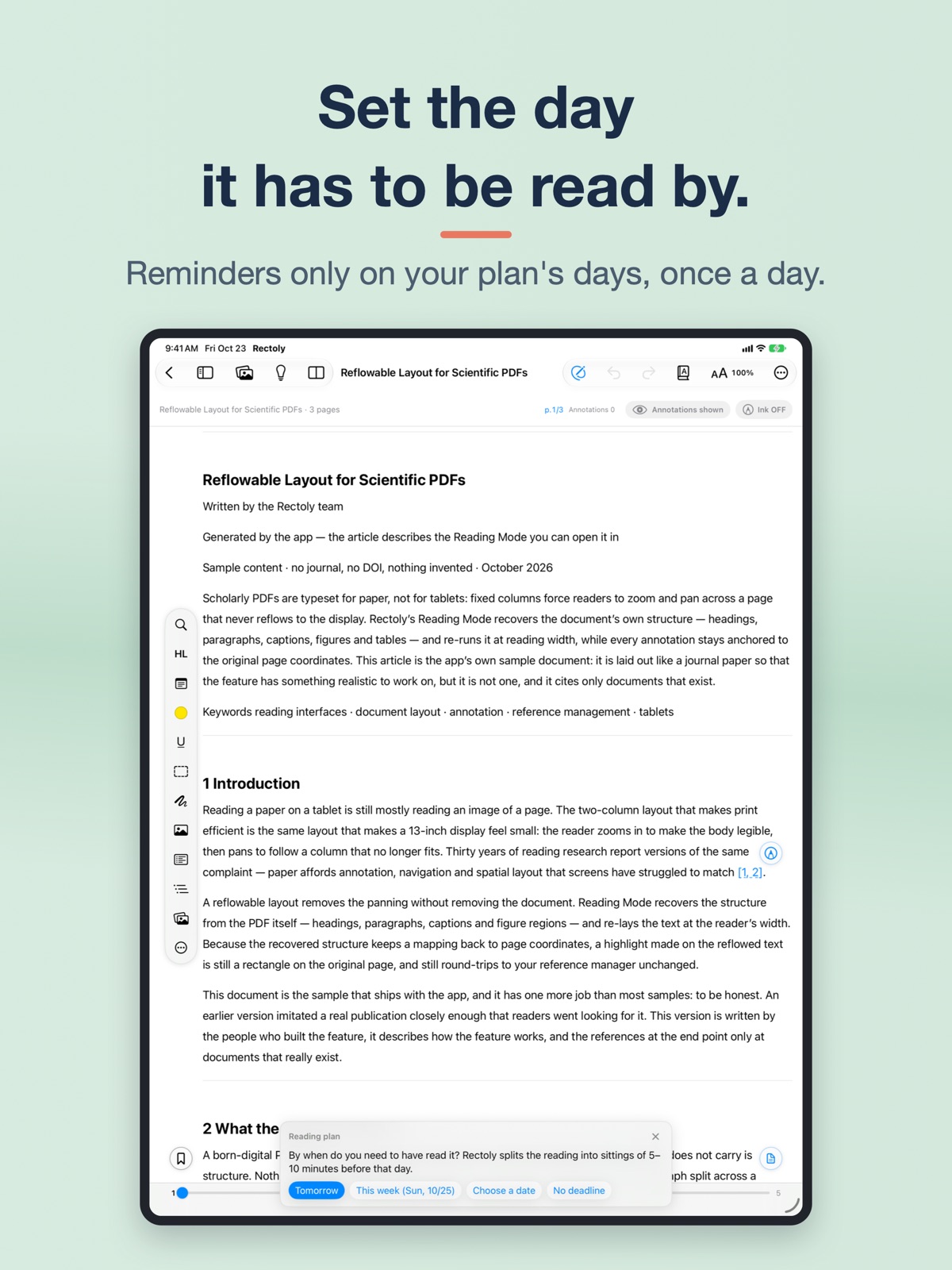
Two things help. Spread the passes over days rather than one sitting: the first pass today, the second tomorrow, the notes the day after, and your summary before the seminar. And read with a deadline in mind, working back from the day you need to have it read by, so that the paper is done before the night before.
How to take notes on a research paper
- Highlight the answer, not the paragraph. One sentence per question. A page that is half yellow tells you nothing a week later.
- Write your own line next to each highlight. In the margin, by hand or typed. The paraphrase is the understanding; the highlight is only the address.
- Keep the page number. Every note that states something the paper says carries its page, so you can find it again when a supervisor asks "where does it say that?".
- Do not copy the abstract into your notes. The abstract is the authors' pitch. Your summary is what you found when you went and looked.
- Compare your summary with the text afterwards. Read your five lines against the sentences you highlighted. Where they differ is where to reread.
When the paper is in English and English is not your first language
Most of the papers you will read are in English, and reading them is a separate skill from understanding them. A few things that work:
- Do the first pass in translation if you need to. Translate the abstract and the conclusion to get the shape of the paper. Then do the second pass with the original in front of you, translating a paragraph at a time where you get stuck, rather than the whole paper at once. Reading the translation alone teaches you nothing about the terms.
- Keep the technical terms in English. Your field discusses them in English, your seminar will use them in English, and a translated term is often a different term.
- Abbreviations are the usual wall. A paper defines each abbreviation once, usually in the introduction or methods, and then uses it fifty times. Find the definition the first time you meet one, and write it in the margin.
- The sentences you cannot parse are usually the methods. They are hard for native speakers too. If the second pass is what you need, skip them.
When you still do not understand the paper
This happens to everyone, including the people who assign the papers. Ask which of the five questions you cannot answer. If it is the research question, go back to the last paragraph of the introduction and the abstract; the paper may assume background you do not have yet, and a review article or a textbook chapter will give it to you faster than rereading. If it is the findings, go back to the main figure and read its caption until you can say what the axes are. If it is the method, you may not need to understand it at this stage; say so in your notes and ask in the lab. Set the paper aside for a day; the second reading is always easier than the first.
Is there an app for reading research papers as a student?
Most PDF apps show you the page. The step that is hard for a first-time reader, knowing what to read next and whether you have found what you were looking for, is left to you. Rectoly: How to Read Papers is an app for iPad and iPhone built around exactly the method above, for students reading their first papers:
- It guides you through a paper in three passes, marking the next part to read and remembering where you stopped.
- It asks the five questions and you find the answers: you highlight the paragraph where you think the paper answers "where does this paper state its purpose?", and the app checks whether your highlight falls where the answer is written. If it is off, it guides you to the right paragraph. It never writes the answer for you, and it never says "wrong".
- In Reading Mode a two-column paper becomes one readable column, the margin shows colours for background, purpose, method, results and limitations, and a tap on an abbreviation jumps to where the paper defines it.
- You sum each question up in your own words, by hand with Apple Pencil or typed, and compare it with the original side by side. Nothing is graded.
- Any paragraph can be translated into your own language on the device; the paper is never sent to a translation service.
- Answer "when do you want to have it read by?" and it spreads the passes over the days, with at most one reminder a day and a Home Screen widget showing the next step. After three days and again after a week it asks you to recall the paper from your own highlights.
- There is no account and no sign-in: open the PDFs you already have from the Files app, including class handouts. Sample papers for your field are free for the first four weeks, your first own PDF is free, every feature is free for 14 days, and after that it is a one-time purchase of $9.99. When you start managing references, you can move up to Rectoly for Zotero or for Mendeley and take your papers, highlights and summaries with you.
The method is the point; the app only keeps you honest about following it.
Frequently asked questions
Where should I start reading a research paper?
Not at the first line. Read the title and abstract, then the figures and their captions, then the last paragraph of the introduction, then the conclusion. That takes five to ten minutes and tells you what the paper asks and what it found. Read the rest afterwards, with those in mind.
How long does it take to read a research paper?
For an experienced reader, five to ten minutes for a first pass and up to an hour for a careful second pass; a deep reading of a paper close to your own work can take four or five hours when you are new to it. Your first papers will take longer, often an afternoon for the second pass, and it gets faster with every paper. Spread the passes over several days rather than one sitting.
Do I need to read the whole paper?
Not every paper, and rarely in order. A first pass decides whether the paper matters to you; a second pass, skipping the details of the methods, is enough for a seminar or for most of the papers in a thesis; only the papers closest to your own work need every section read in detail.
What is the most important part of a research paper?
For understanding what it found: the figures and the conclusion. For understanding what it is about: the last paragraph of the introduction, where the authors state the research question. For judging it: the methods and the limitations the authors state themselves.
How do I know whether I have understood a paper?
If you can point to where the paper answers five questions, the research question, the method, the data, the findings and the limitations, and write one line in your own words for each, you have understood it well enough to discuss it. If one line will not come, that question is where to reread.
How should I read a paper I have to present in a seminar?
Do the first pass a week before, the second pass over two or three days, and write your five lines. Build the presentation around the main figure: what was asked, how, what the figure shows, what the authors say it cannot show. Prepare for the one question you will be asked: what would you have done differently?
Is there an app for reading research papers on an iPad as a student?
Rectoly: How to Read Papers is built for students reading their first papers: it guides the three passes, asks the five questions and checks your highlights, lets you sum the paper up in your own words, translates paragraphs on the device, and plans the reading back from your deadline. It works on the PDFs you already have, with no account.
Is Rectoly: How to Read Papers free?
The sample papers and your first own PDF are free, and every feature is free for 14 days. After that it is a one-time purchase of $9.99 for iPad and iPhone; there is nothing to renew.